 Bullflow
Call Option vs Put Option
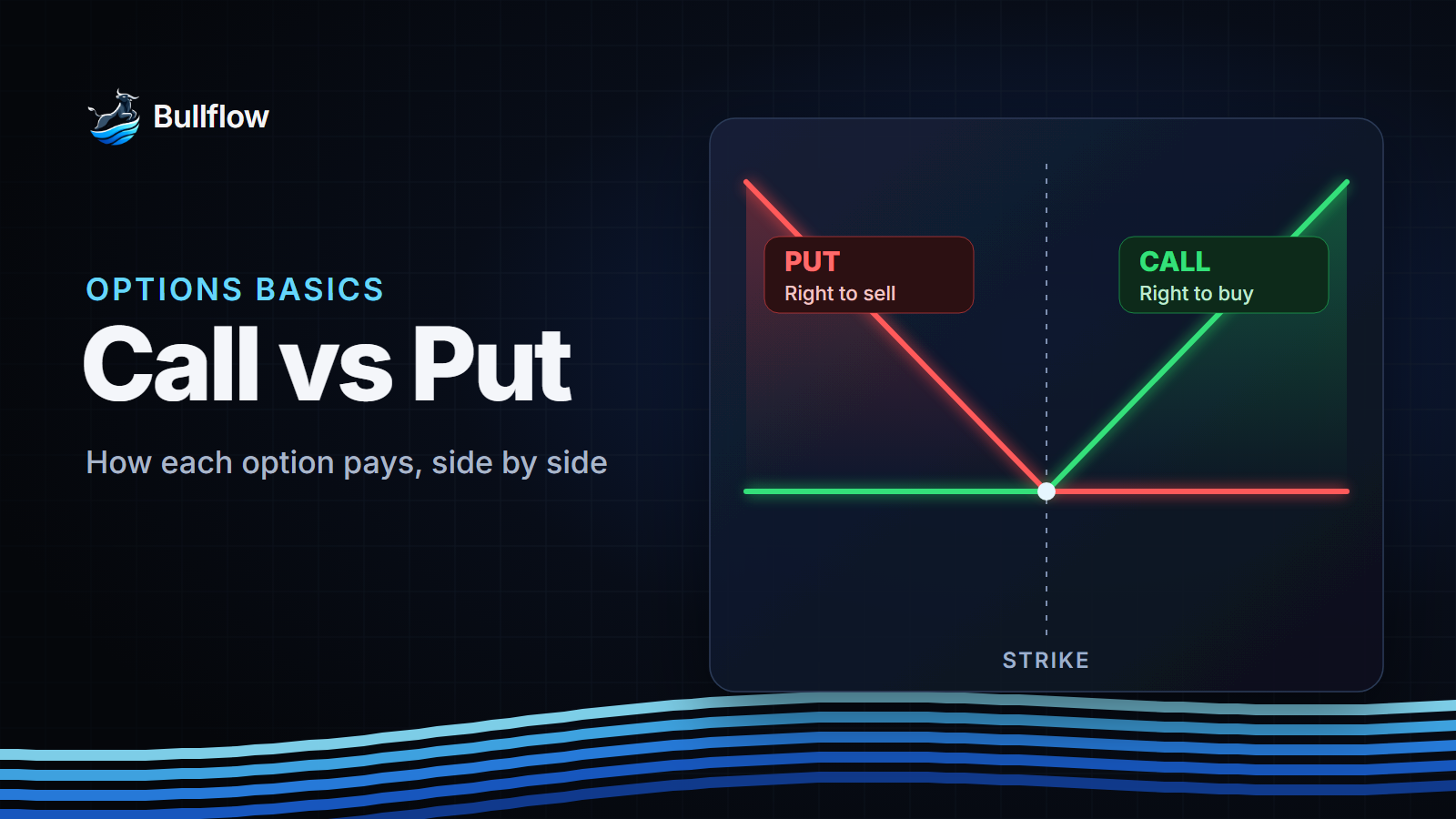
A call option gives its holder the right to buy a stock at a fixed price, called the strike, until the option expires. If the stock rises above the strike, the holder can buy for less than the market price. The higher it rises, the more the call is generally worth.
A put option gives its holder the right to sell at the strike. If the stock falls below the strike, the holder can sell for more than the market price. The further it falls, the more the put is generally worth.
How a call option works
The holder of a call is the person who buys it, and the price paid is called the premium. The holder doesn't have to use the right; it isn't an obligation.
The seller, called the writer, collects the premium and takes on the obligation. Using the right is called exercising. When a holder exercises, a writer is assigned and must sell the shares at the strike.
Illustrative example: stock XYZ trades at $50. A holder buys an XYZ 50 call, meaning a call with a $50 strike, for $2 a share. One contract usually covers 100 shares, so it costs $200.
At expiration, the call is worth $100 for each $1 that XYZ ends above $50:
- XYZ at $50 or below: the call expires worthless. The holder loses the $200 and nothing more.
- XYZ at $51: the call is worth $100, still $100 short of the $200 paid.
- XYZ at $52: the call is worth $200, exactly what was paid. This is the break-even: the strike plus the premium.
- XYZ at $56: the call is worth $600, a $400 gain after the premium.
A call with the stock above its strike, as at $51 or $56, is called "in the money". In the money isn't the same as a profit: at $51, the holder is still behind.
The most a call holder can lose is the premium. In theory, the gain has no cap.
How a put option works
A put holder pays the premium for the right to sell the stock at the strike until expiration. When a put holder exercises, an assigned writer must buy the shares at the strike.
Illustrative example: with XYZ at $50, a holder buys an XYZ 50 put for $1.50 a share, or $150 per contract.
At expiration, the put is worth $100 for each $1 that XYZ ends below $50:
- XYZ at $50 or above: the put expires worthless. The holder loses the $150 and nothing more.
- XYZ at $49: the put is worth $100, still $50 short of the $150 paid.
- XYZ at $48.50: the break-even, the strike minus the premium.
- XYZ at $45: the put is worth $500, a $350 gain after the premium.
A put with the stock below its strike, as at $49 or $45, is in the money.
The most a put holder can lose is the premium. The gain has a ceiling, because a stock can't fall below zero: $4,850 per contract here, if XYZ goes to $0.
Because a put gains as the stock falls, a shareholder can buy one on shares already owned. Until the put expires, it lets the shareholder sell at the strike however far the stock drops. The Options Industry Council (OIC) calls this a protective put. It says the put sets a floor under the shares' value and compares it to homeowner's insurance. The premium is the cost of that floor.
The other side: option writers
Writers receive the premium in exchange for the holder's right. They keep it whether or not the option is exercised. Their risk comes from the obligation.
- Call writer: if assigned, must sell shares at the strike. A writer who owns the shares is "covered". An uncovered writer's possible loss has no limit, because the stock can keep rising. The uncovered writer of the XYZ 50 call loses $400 with XYZ at $56, and $100 more for each further $1.
- Put writer: if assigned, must buy shares at the strike. The loss grows as the stock falls, and the stock can fall to zero. The writer of the XYZ 50 put would lose $4,850 if XYZ went to $0.
A writer can end the obligation early by buying the same option back, as long as it hasn't been assigned yet. Writers usually have to deposit cash or securities with their broker, called margin, as collateral for the obligation. Uncovered writers may have to add more if the stock moves against them.
Call option vs put option at a glance
| Call option | Put option | |
|---|---|---|
| Holder's right | Buy at the strike | Sell at the strike |
| Generally gains value when | The stock rises | The stock falls |
| In the money when | The stock is above the strike | The stock is below the strike |
| Break-even at expiration | Strike plus premium | Strike minus premium |
| Holder's largest loss | The premium | The premium |
| Holder's largest gain | No cap, in theory | Strike minus premium, per share |
| Writer, if assigned | Sells shares at the strike | Buys shares at the strike |
| Writer's largest loss | No limit, if no shares are held | Strike minus premium, per share |
What an option's premium is made of
A premium has two parts: intrinsic value and time value, also called extrinsic value.
- Intrinsic value: how far an option is in the money. For a call, the stock price minus the strike. For a put, the strike minus the stock price. Only an in-the-money option has any.
- Time value: any premium above the intrinsic value, before expiration. The more time left, the more time value.
Two more terms complete the picture. An option is "at the money" when the stock price equals the strike. It's "out of the money" when a call's strike is above the stock price, or a put's strike is below it.
In the XYZ example, both options were at the money when bought, so neither had any intrinsic value. Their whole premiums, $2 and $1.50, were time value.
Now say XYZ rises to $53 before expiration. The call has $3 of intrinsic value, and any premium above $3 is time value. The put is now out of the money, so its whole premium is time value.
At expiration, time value is gone and only intrinsic value is left. With XYZ still at $53, the call is worth $3 a share and the put nothing.
What moves calls and puts before expiration
Before expiration, the stock price, the time left and implied volatility all affect a premium. Traders estimate each effect with a measure called a Greek, a theoretical guide rather than a guarantee.
Stock price: delta. Delta estimates how much a premium may change for a $1 move in the stock. A bought call has a delta between 0 and 1. A bought put has a delta between 0 and −1, meaning it loses value as the stock rises.
Say the XYZ call has a delta of 0.50 and the put −0.50, both made-up values. A $1 rise in XYZ adds about $50 per contract to the call and takes about $50 off the put.
Time: theta. Theta estimates how much a premium may lose per day, with everything else unchanged. It's likely to become increasingly negative as expiration nears.
Time value erodes for calls and puts alike, most noticeably for at-the-money options. Say the XYZ call has a theta of −0.03 and the put −0.025, both made-up values. With nothing else changing, the call loses about $3 per contract per day and the put about $2.50.
So, all else equal, a holder who waits for a move typically sees time value erode each day. That's why a holder must be right about when the move happens, not only its direction.
Implied volatility: vega. Implied volatility is a measure of the stock's predicted future movement, solved for from option prices. It tends to rise ahead of news and fall in calm periods. Higher implied volatility means bigger expected moves in either direction, which generally raises call and put premiums alike.
Vega estimates the change in premium for each 1-point change in implied volatility. With a made-up vega of $0.05, a 2-point rise adds about $10 per contract to each XYZ option.
What separates calls from puts: a rising stock generally lifts calls and lowers puts. Time and implied volatility generally affect bought calls and bought puts the same way.
Exercise, assignment or selling first
A holder doesn't have to exercise. Before expiration, the option can be sold to another buyer instead. Holders often do that. Selling may have lower transaction costs than exercising, and it can capture any time value left in the price.
At expiration, many brokers have procedures to exercise options that are in the money by a set amount. If XYZ ends at $51, $1 in the money, the call may be exercised, depending on that amount. The holder would then pay $5,000 for shares worth $5,100. After the $200 premium, that's still a $100 loss.
Options that expire out of the money, like the call with XYZ below $50, are usually left to expire with no value.
A writer whose option expires in the money should expect assignment, though it isn't guaranteed.
Calls and puts in real trading
The XYZ examples are made up. Real trades follow the same rules: each has a type, a strike, an expiration and a premium. Here are real calls and puts on SPY, an exchange-traded fund (ETF) that aims to track the S&P 500 index. SPY closed at $753.55 on Nov 13, 2026.
The table shows SPY's 6 largest options trades that session by premium, from the trades Bullflow records. Premium is the total premium Bullflow lists for the trade.
| Type | Strike | Expiration | Contracts | Premium |
|---|---|---|---|---|
| Call | 700 | 2028-12-15 | 599 | $8.8M |
| Call | 600 | 2027-06-30 | 200 | $3.4M |
| Call | 840 | 2028-12-15 | 500 | $3.3M |
| Put | 755 | 2026-11-13 | 7,828 | $3.2M |
| Put | 737 | 2026-11-20 | 6,058 | $2.4M |
| Put | 755 | 2026-11-13 | 4,000 | $2.4M |
Source: Bullflow's free closing options flow summary, SPY, Nov 13, 2026 (API docs).
Two rows, read with the XYZ rules:
- Largest call by premium: 599 contracts with a $700 strike, expiring Dec 15, 2028, for $8.8M. Each is the right to buy SPY at $700 until then. SPY closed above the $700 strike, so this call was in the money at the close.
- Largest put by premium: 7,828 contracts with a $755 strike, expiring Nov 13, 2026, the same day as the trade, for $3.2M. Each is the right to sell SPY at $755. SPY closed below the $755 strike, so this put was in the money at the close.
Three limits on reading these rows:
- The trades happened at different times of day, when SPY's price may have differed from its close. The in-the-money labels use the close.
- In the money says nothing about whether a trade made money. That depends on the price paid, as the XYZ call at $51 shows.
- This table doesn't show whether a trade was a purchase or a sale, or whether it opened or closed a position. So neither row shows a bet on direction.
See more on Bullflow's SPY options flow page, or options flow for other tickers.
Call and put option FAQ
How long do call and put options last?
Each option has a set expiration date. For a given stock's options, there are generally at least four expiration dates to choose from at any time.
Can a call or put option be exercised before expiration?
It depends on the option's style. An American-style option can be exercised at any time before expiration. Every European-style option traded at the time could be exercised only on its expiration date, according to the Options Clearing Corporation's June 2024 guide.
What happens if a call or put option holder does nothing at expiration?
An option that ends out of the money usually expires with no value, and the holder loses the whole premium. If it ends in the money by a set amount, many brokers exercise it under their own procedures. For a call, that means buying the shares at the strike; for a put, selling them.
Do call and put option holders get dividends or voting rights?
No. Holders of stock options don't have shareholder rights such as voting or dividends. To get those rights, a call holder must exercise the call and take ownership of the shares.
How does buying a call option compare with buying 100 shares?
With XYZ at $50, one call costs $200 and 100 shares cost $5,000. The call's largest loss is $200, against $5,000 at stake in the shares, but that $200 is all of the money put in. More leverage means more upside and more risk of loss.
If XYZ ends at $48, both lose $200. For the call that's its whole cost; for the shares it's 4%. If XYZ ends at $56, the call gains $400, or 200%, and the shares gain $600, or 12%.
Is buying a put option the same as writing a call option?
No. They're distinct types of options. A put holder has the right to sell, while a call writer has an obligation to sell if assigned. A put holder profits if the stock falls far enough, and can lose at most the premium. A call writer keeps the premium either way, but an uncovered writer faces a loss with no limit if the stock rises.
Related: Bullflow's guide to gamma exposure (GEX).
For information only. Not investment advice. Options carry significant risk and are not suitable for all investors.