 Bullflow
Gamma in Options: What It Is and How It Works
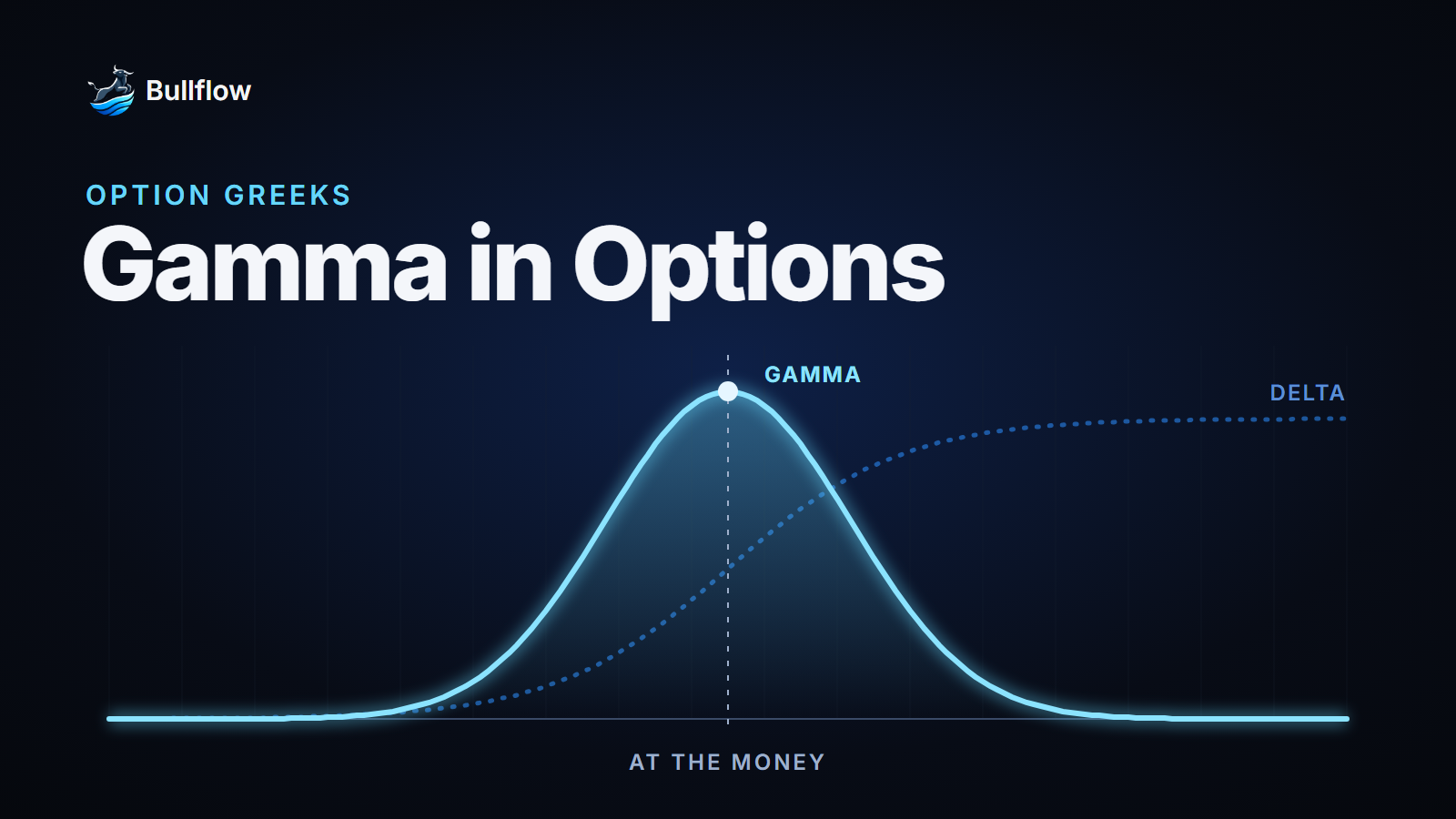
Gamma in options is the expected change in an option's delta for a $1 move in the underlying stock. Delta is how much an option's price is expected to change for that $1 move, so gamma tells you how fast delta itself changes.
Gamma is highest for options that are at the money, with the stock price near the strike, and close to expiration. That's why short-dated options can swing so sharply.
What is gamma in options?
Gamma is written as a decimal, such as 0.05. It assumes everything else about the option stays the same. Only options have gamma; a share of stock always has a delta of 1.
Example: a call has a delta of 0.40 and a gamma of 0.05.
| Stock move | New delta (approx.) |
|---|---|
| Up $1 | 0.45 |
| No change | 0.40 |
| Down $1 | 0.35 |
Long calls and long puts both have positive gamma, and sold calls and puts have negative gamma. A put's delta is negative, but a bought put's gamma is still positive.
Gamma vs delta
| Delta | Gamma | |
|---|---|---|
| Measures | Change in the option's price per $1 move in the stock | Change in delta per $1 move |
| Range | 0 to 1 for calls, 0 to −1 for puts | Near 0 deep in or out of the money; largest at the money |
| Think of it as | Shares the option acts like | How fast that share count changes |
Where gamma is highest
Gamma is highest when the stock price is near the strike, so the option is at the money. It falls as an option moves deeper in or out of the money, where delta has little room left to change.
For near-the-money options, gamma also rises as expiration gets closer. A near-the-money option expiring today can see its delta jump from about 0.50 toward 1 or 0 on a small move.
Long gamma vs short gamma
Owning options makes a position long gamma, also called positive gamma. Its delta rises as the stock rises and falls as the stock falls. Large moves in either direction tend to help, while time decay works against it.
Selling options makes a position short gamma, or negative gamma. Delta moves against the position as the stock moves. Large moves tend to hurt, while time decay works in its favor.
Negative gamma meaning, in one line: as the stock moves, the position's delta shifts against it, so its exposure to the move grows the further the move goes.
Gamma scalping
Gamma scalping is a way of trading around a long gamma position. As the stock rises, the position's delta grows, and the trader sells shares to bring delta back to neutral. As it falls, they buy shares back.
The aim is for those share trades to earn more than the options lose to time decay. It works only if the stock moves enough.
Why gamma matters for dealers and GEX
Market makers hedge the delta of the options they sell. Gamma sets how often and how much they have to re-hedge as the price moves.
Add up that gamma across every strike and expiration, weighted by open interest, and you get gamma exposure, or GEX. The GEX guide explains how it's calculated, and Bullflow's GEX heatmap shows it by strike. If dealers have sold calls, they are short gamma, and buying shares to hedge them can add upward pressure on the stock; see What is a gamma squeeze.
Gamma in options FAQ
What does gamma measure in options?
Gamma measures how much an option's delta is expected to change when the underlying stock moves $1.
Is gamma highest for at-the-money options?
Yes. Gamma is highest for options at the money and close to expiration, and it falls as an option moves deeper in or out of the money.
What does negative gamma mean in options?
Negative gamma means a position's delta moves against it as the stock moves, which happens when the position has sold options.
What is the difference between gamma and delta in options?
Delta is how much an option's price changes for a $1 move in the stock. Gamma is how much delta changes for that same move.
What is gamma scalping in options?
Gamma scalping is trading shares against a long options position to keep its delta near neutral as the stock moves, aiming to earn more than the options lose to time decay.
For information only. Not investment advice. Options carry significant risk and are not suitable for all investors.