 Bullflow
Selling a Put Option: How It Works and the Risks
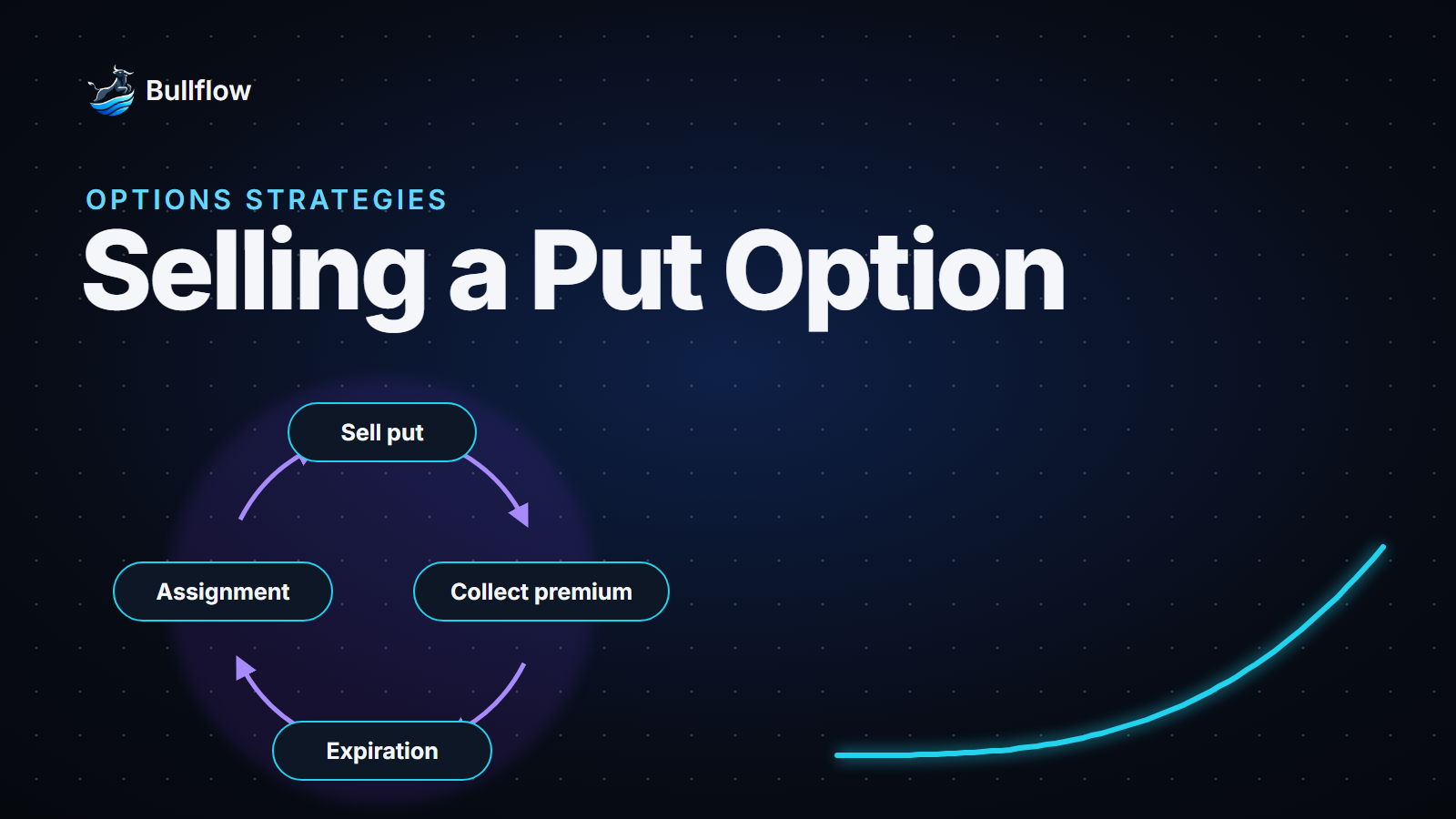
Selling a put option, also called writing a put, pays the seller a premium up front. In return, the seller takes on an obligation to buy the shares, usually 100 per contract, at a fixed price, the strike, if the buyer exercises. Exercising means the buyer uses the right to sell the shares at the strike. The most the seller can gain is the premium. The loss grows as the stock falls, to a maximum of the strike minus the premium. New to options? Start with options trading for beginners.
Why traders sell puts, and the outlook it implies
The Options Industry Council (OIC) describes two motives. This is how the OIC frames the strategy. It is not a recommendation.
- Collect the premium. For a naked put, the OIC says the only motive is "to earn premium income".
- Be willing to buy the stock at the strike. For a cash-secured put, the OIC calls it "primarily a stock acquisition strategy for a price-sensitive investor". The goal is to be assigned and buy the stock below its market price.
Both carry the same outlook. The OIC labels the short put "neutral to moderately bullish": the seller expects a steady or rising stock price. For the cash-secured version, it adds a short-term dip, then a longer-term rise.
Naked and cash-secured puts are explained below.
What it means to sell a put option
A put option gives its holder the right to sell the shares at the strike before the option expires. The writer, or seller, of the put has the obligation to buy those shares. The put option post covers the buyer's side. For the buyer-versus-writer comparison, see call option vs put option.
A trader who opens a short put position by selling it is said to "sell to open" or "write" it. The seller receives the premium, the option's price. That gives the seller a net credit, meaning money comes in when the position opens. The premium is quoted per share, and one contract usually covers 100 shares. The options premium post explains what makes up that price.
Three more terms matter for a put:
- In the money: the stock is below the strike.
- At the money: the strike equals the stock's current price.
- Out of the money: the stock is above the strike.
Assignment is notification that an owner of an option has exercised. The writer's brokerage firm then assigns one of its customers.
Illustrative example: stock XYZ trades at $50. A seller writes one XYZ 50 put, meaning a put with a $50 strike, and receives a premium of $2.00 a share.
- Premium received: $2.00 x 100 shares = $200.
- Obligation if assigned: buy 100 shares at $50, which costs $5,000.
The seller keeps the premium whether or not the put is exercised. The buyer, not the seller, decides whether to exercise.
What the seller can gain and lose
The break-even for the XYZ 50 put is the strike minus the premium, $50 − $2.00 = $48 a share. At expiration, the XYZ 50 put works like this:
- XYZ at $50 or above: the put expires worthless and the seller keeps the $200. This is the most the seller can gain.
- XYZ at $49: the seller buys at $50 shares worth $49, a $100 loss on the shares. The $200 premium leaves a $100 net gain.
- XYZ at $48: the shares lose $200, exactly the premium. This is the break-even.
- XYZ at $45: the shares lose $500, so the seller is $300 behind after the premium.
- XYZ at $0: the shares lose $5,000, so the seller is $4,800 behind. This is the maximum loss, $48 a share on 100 shares.
The gain is capped at the premium. The loss is limited because a stock cannot fall below zero, but the OIC calls it substantial. The OIC calls the maximum gain "very limited" next to the risk.
If assigned, the effective price paid for the shares is the strike minus the premium. Here that is $48 a share.
Assignment: how a put seller ends up owning shares
Assignment is the notice that a holder has exercised. The brokerage firm must assign one of its customers who wrote that option, at random or first-in, first-out depending on the firm.
When assignment can happen:
- American-style options can be exercised at any time before expiration. A writer can therefore be assigned at any time before expiration.
- The OIC says early assignment generally occurs when the put goes deep in the money. It adds that most professional option traders exercise deep in-the-money puts before expiration.
- An equity option $.01 or more in the money at expiration is exercised unless the clearing member is told otherwise. A writer whose put expires in the money should expect assignment, though it isn't guaranteed. Some holders choose not to exercise.
Once assigned, the writer has no choice but to meet the contract terms. Before assignment, a writer can end the obligation by buying the same put back, called a "buy to close."
Illustrative example: the XYZ 50 put's price rises from $2.00 to $3.50 before assignment. While the seller still holds the put, the position shows an unrealized loss of $150, a loss on paper. Buying the put back costs $350 against the $200 received. That realizes the $150 loss.
Cash-secured put vs naked put
Both are short puts. They differ in how the obligation is backed.
In options, margin is the cash or securities a writer deposits with a brokerage firm as collateral for the obligation on a short option. Minimum margin requirements come from the options markets and other self-regulatory organizations, and brokerage firms can require more.
| Cash-secured put | Naked put | |
|---|---|---|
| Backing | The seller sets aside the cash to buy the shares if assigned | No reserved cash to buy the shares |
| XYZ 50 put example | $5,000 set aside | Margin held by the broker |
| What the OIC says about the seller's goal | A cash-secured writer "actually wants to acquire the underlying stock via assignment" | A naked writer's "only goal is to collect premium income" |
| If assigned | Cash on hand pays for the shares | The seller may need to liquidate other assets quickly or borrow cash |
In the XYZ 50 example, both have the same premium, break-even and maximum loss at expiration.
For a naked put, the OIC says the risk is well above the initial margin. An unfavorable move could force the seller to post more margin on short notice, or to close the position at a substantial loss. Cboe says uncovered writers may have to meet calls for substantial additional margin when the market moves against them.
The OIC notes that a cash-secured put's maximum loss is lower than owning the stock outright, because the premium received offsets part of it.
What moves a short put before expiration
The OIC discusses two factors that affect a naked put strategy:
- Time passing: the effect on the seller is "extremely positive," all else equal. Each day lowers the likelihood that an at-the-money or out-of-the-money put ends in the money.
- Implied volatility: a measure of how much the market expects the stock to move, based on the option's price. A rise has a negative impact on the seller, all else equal. It normally raises the cost of buying the put back.
Selling puts in real options flow: reading the Fill column
The XYZ numbers are made up. Real put trades have the same parts: a strike, an expiration and a premium. Bullflow's options flow data records where in the quote each trade happened in a field the data calls execution. This post labels that column Fill.
The takeaway: large SPY put trades happen on both sides of the quote. A Fill value alone doesn't show whether a trader opened or closed a position.
First, two terms. The bid is the highest price a buyer will pay at a given time. The ask is the lowest price a seller will accept. Bullflow records the option's bid and ask at the time of each trade. Fill is Bid when the trade happened at the bid and Ask when it happened at the ask. Above Ask is a trade above the ask price.
For a put, that suggests the following. It is an inference from the definitions, not a stated fact:
- Bid: the trade happened at the price buyers were offering, which suggests a seller hit the bid. That pattern suggests a put was sold.
- Ask or Above Ask: the trade happened at or above the price sellers were asking, which suggests a buyer paid the seller's price. That pattern suggests a put was bought.
SPY is a fund that seeks results corresponding generally, before expenses, to the price and yield performance of the S&P 500. It closed at $715.67 on Nov 25, 2026. The table shows 6 of that session's largest-premium SPY trades, which were all puts.
| Time | Type | Strike | Expiration | Contracts | Premium | Fill |
|---|---|---|---|---|---|---|
| 14:56 UTC | Put | 740 | 2026-12-18 | 3,107 | $13.1M | Above Ask |
| 20:38 UTC | Put | 750 | 2026-11-30 | 3,570 | $12.8M | Bid |
| 20:27 UTC | Put | 750 | 2026-11-30 | 3,100 | $10.6M | Ask |
| 20:38 UTC | Put | 745 | 2026-11-30 | 3,040 | $9.5M | Ask |
| 14:44 UTC | Put | 850 | 2029-01-19 | 433 | $6.8M | Bid |
| 20:38 UTC | Put | 737 | 2026-11-27 | 2,570 | $6.0M | Ask |
Source: Bullflow free closing options flow summary and closing GEX summary (for the close), SPY, Nov 25, 2026 (API docs).
The columns: Time is the trade time in UTC. Contracts is the number of contracts, each covering 100 shares. Premium is the trade's total premium in US dollars. The other columns are the strike, expiration and Fill described above.
Among the 6 shown, the largest put with a Bid fill was 3,570 contracts with a $750 strike, expiring Nov 30, 2026, for $12.8M in total premium. The largest of the 6 with an Ask fill has the same strike and expiration: 3,100 contracts for $10.6M. The Time column shows them at 20:38 and 20:27 UTC.
The data can't say why two trades in one contract hit opposite sides of the quote. They could be different traders, or two parts of one larger position.
One Bid row stands out: 433 contracts at a $850 strike expiring Jan 19, 2029, for $6.8M in total premium. SPY closed at $715.67, below that strike, so the put was deep in the money. A long-dated, deep in-the-money put sold at the bid may be protection for another position or a closing trade. The data can't tell.
Fill suggests, doesn't prove. Bullflow says execution-side direction "does not establish opening positions or trader intent". A put sold at the bid could be a holder selling an existing put to close it, not a writer opening a new one. The table covers only the largest trades by premium, so it says nothing about all SPY puts that session.
See more on Bullflow's unusual options flow page.
Selling a put option FAQ
Why do traders sell put options?
The OIC gives two motives: to earn premium income, and, for a cash-secured put, to buy the stock below its market price through assignment. It labels both outlooks neutral to moderately bullish.
What does "sell to open" a put option mean?
Selling to open means opening a short position by selling the option. It obligates the writer to fulfill their side of the contract if the holder exercises. For a put, that side is buying the shares at the strike if assigned.
Can a put option seller be assigned before expiration?
Yes. A writer of an American-style option can be assigned at any time before expiration. The OIC says early assignment generally happens when the put goes deep in the money.
How can a put option seller end the obligation before assignment?
A writer can buy an offsetting put, called a "buy to close," as long as the writer hasn't been assigned. To avoid assignment on a given day, the position must be closed before that day's market close.
What is the difference between a long put and a short put?
A long put holder, the buyer, has the right to sell the shares at the strike. A short put writer has the obligation to buy them. The holder's loss is limited to the premium paid, while the writer's loss potential for a put is substantial.
How does selling a put option differ from selling a call option?
A call seller is obligated to sell the shares at the strike if assigned, and a put seller is obligated to buy them. See sell call option for the call side.
Drafted with AI help; figures checked by the Bullflow team.
For information only. Not investment advice. Options carry significant risk and are not suitable for all investors.