 Bullflow
In the Money Options: ITM, ATM and OTM Explained
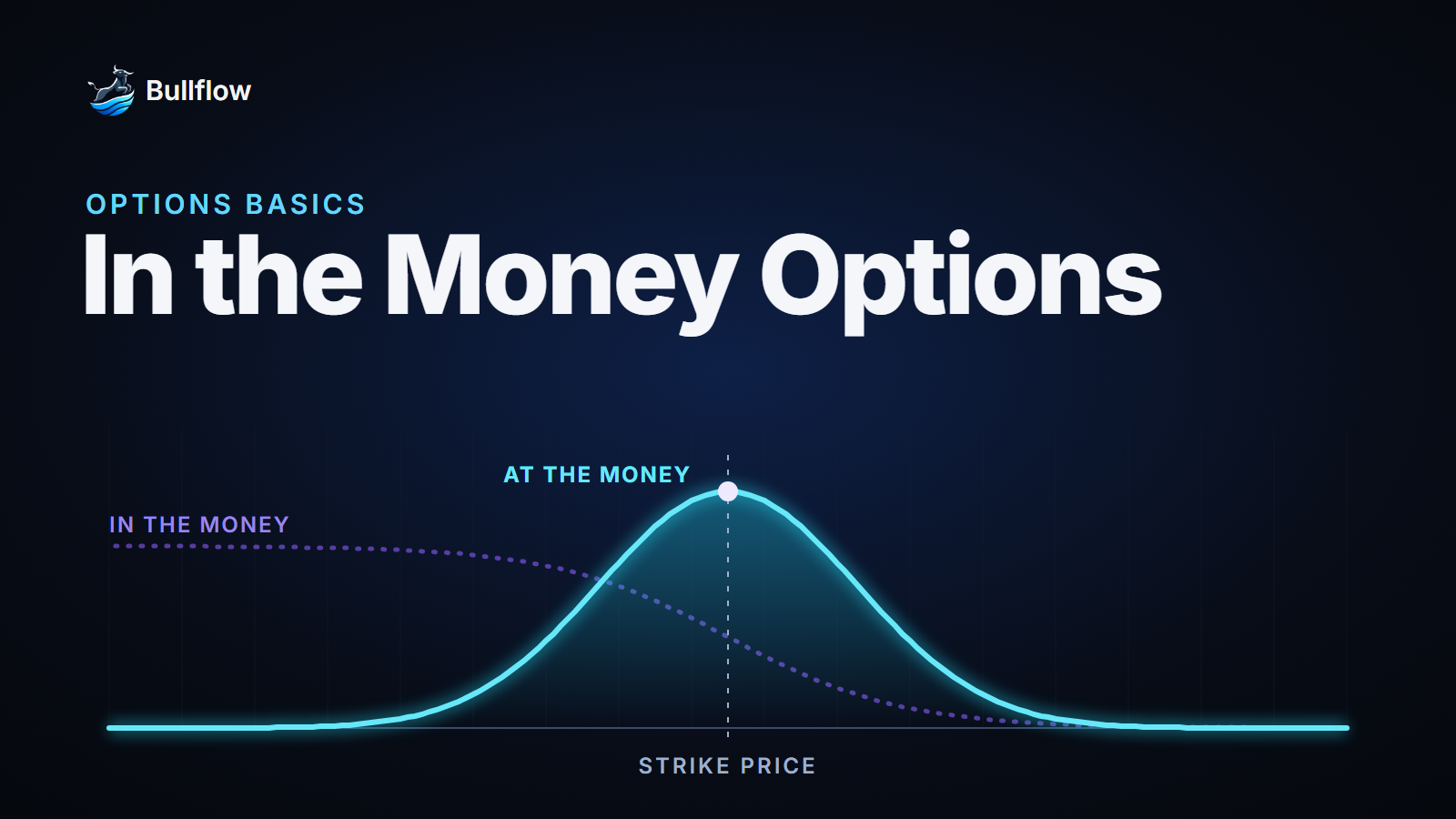
ITM stands for "in the money." A call option is in the money when the stock trades above its strike price. A put option is in the money when the stock trades below it.
At the money (ATM) means the strike equals the stock price. Out of the money (OTM) means a call with the stock below its strike, or a put with the stock above it. The strike is the price at which the contract may be exercised. New to options? Start with options trading for beginners.
ITM meaning: in the money for calls and puts
Every option is a right to buy (a call) or sell (a put) at the strike. Compare that strike with the stock's current price. The comparison flips between calls and puts.
Illustrative example: stock XYZ trades at $50. The table shows six XYZ options, three calls and three puts, with strikes of $45, $50 and $55.
| Strike | XYZ call | XYZ put |
|---|---|---|
| $45 | In the money: stock is $5 above the strike | Out of the money: stock is above the strike |
| $50 | At the money: stock equals the strike | At the money: stock equals the strike |
| $55 | Out of the money: stock is below the strike | In the money: stock is $5 below the strike |
The right to buy at $45 is worth something when shares cost $50, and so is the right to sell at $55. The same strike can be in the money for one type and out of the money for the other. The XYZ 45 call is in the money while the XYZ 45 put is out of the money. For the two types side by side, see call option vs put option.
Intrinsic value and time value
Where an option sits matters because it decides how an option's price, the premium, splits into two parts. The premium is quoted per share, and one contract usually represents 100 shares.
- Intrinsic value: the amount an option is in the money. Only in-the-money options have it.
- Time value: any premium above the intrinsic value, before expiration.
An at-the-money or out-of-the-money option has no intrinsic value, so its whole premium is time value.
Illustrative example: XYZ rises to $53, and the premiums below are made up.
| Option | Premium | Intrinsic value | Time value |
|---|---|---|---|
| XYZ 50 call (in the money) | $4.20 | $3.00 | $1.20 |
| XYZ 55 call (out of the money) | $1.10 | $0 | $1.10 |
| XYZ 55 put (in the money) | $3.00 | $2.00 | $1.00 |
The XYZ 50 call is $3 in the money, because $53 minus $50 is $3. The remaining $1.20 of its $4.20 premium is time value. Per contract, that is $420 of premium, made of $300 intrinsic value and $120 time value.
Why in the money, at the money and out of the money matter
For the premium. An option's premium generally rises as it moves further in the money and falls as it moves deeper out of the money.
Over time. The longer an option has until expiration, the greater its time value. As expiration approaches, time value erodes for both puts and calls, most noticeably for at-the-money options.
Position changes. The stock price moves, so an out-of-the-money option can end up in the money, and the reverse.
Break-even: why in the money is not the same as profit
OIC says a long call, one the investor bought, breaks even at expiration when the stock price equals the strike price plus the initial cost of the call. A long put breaks even when the stock price equals the strike price minus the cost of the option. The examples below ignore commissions.
In the XYZ example, the buyer paid $4.20 for the XYZ 50 call. Break-even is $50 plus $4.20, or $54.20. At $53 the call is in the money but below break-even, a $1.20 loss per share, or $120 per contract.
The XYZ 55 put bought at $3.00 breaks even at $55 minus $3.00, or $52. The most a buyer can lose is the premium paid.
What happens to an in-the-money option at expiration
It is usually exercised automatically. Exercise means using the right to buy or sell at the strike. FINRA says standardized equity options that are in the money will generally be exercised automatically at expiration. OIC describes an exercise-by-exception threshold of $.01 in the money for equity options in a customer account. That threshold triggers automatic exercise only in the absence of contrary instructions from the clearing member.
Exercising a call costs real money. FINRA's example: a call with a $100 strike needs $10,000 to exercise. The broker must require full cash payment for a call, or the required margin deposit in a margin account. For the XYZ 50 call, 100 shares at $50 is $5,000.
Holders can sell instead. A holder can trade the contract to close the position, or let it expire worthless.
Writers face assignment. The writer (or seller) of a call has the obligation to sell the shares. The writer of a put has the obligation to buy them. A writer may be assigned an exercise notice. A writer whose option expires in the money should expect assignment, though it is not guaranteed.
It can come early. The holder of an American-style option can exercise at any time before expiration. Assignment can then arrive days or weeks before expiration. Call writers should watch dividend dates for this reason.
Deep in the money and deep out of the money
"Deep" describes an option far in or out of the money. The sources used here give no cutoff for it.
Illustrative example: with XYZ at $50, an XYZ 35 call is deep in the money, $15 below the stock price. Say its premium is $15.10, made up. Then $15.00 is intrinsic value and $0.10 is time value.
An XYZ 70 call is deep out of the money. Say its premium is $0.05, made up. It has no intrinsic value, so all $0.05 is time value.
Delta is a theoretical estimate of how much an option's premium may change given a $1 move in the stock. OIC says deep-in-the-money options have a much larger delta. Near expiration, in-the-money call deltas rise toward 1.00, at-the-money call deltas stay near 0.50, and out-of-the-money call deltas fall toward 0.
Some traders read delta as the rough chance an option ends in the money at expiration. That is a rule of thumb, not a forecast.
Real SPY trades next to the closing price
XYZ is made up, but real trades follow the same rule. SPY is a fund that seeks to correspond generally, before expenses, to the price and yield performance of the S&P 500. The tables below use SPY's largest trades by premium, as recorded by Bullflow, next to that day's closing price.
A put at the close: Nov 25, 2026
SPY closed at $715.67 on Nov 25, 2026. The table shows the session's largest trades by premium, and every one of them is a put. The close shows which side of its strike each put landed on.
| Type | Strike | Expiration | Contracts | Premium |
|---|---|---|---|---|
| Put | 740 | 2026-12-18 | 3,107 | $13.1M |
| Put | 750 | 2026-11-30 | 3,570 | $12.8M |
| Put | 750 | 2026-11-30 | 3,100 | $10.6M |
| Put | 745 | 2026-11-30 | 3,040 | $9.5M |
| Put | 850 | 2029-01-19 | 433 | $6.8M |
| Put | 737 | 2026-11-27 | 2,570 | $6.0M |
Source: Bullflow free closing options flow summary and closing GEX summary, SPY, Nov 25, 2026 (API docs).
For a put, in the money means the close is below the strike. The largest put by premium was 3,107 contracts with a $740 strike, expiring Dec 18, 2026, for $13.1M. SPY closed below the $740 strike, so this put was in the money at the close.
Every strike in this table is above the close, so every put shown was in the money at the close. Some strikes sit well above the price, and one expires in 2029. The data can't say why. Long-dated or deep-in-the-money puts, parts of larger trades or protection for other positions are possible.
Calls and a put at the close: Nov 18, 2026
SPY closed at $729.69 on Nov 18, 2026. That session's largest trades are mostly calls, with one put at the top.
| Type | Strike | Expiration | Contracts | Premium |
|---|---|---|---|---|
| Put | 610 | 2027-03-19 | 15,000 | $10.5M |
| Call | 490 | 2026-12-18 | 396 | $9.5M |
| Call | 495 | 2026-12-18 | 400 | $9.5M |
| Call | 495 | 2026-12-18 | 391 | $9.3M |
| Call | 345 | 2026-12-18 | 224 | $8.6M |
| Call | 800 | 2028-12-15 | 1,000 | $7.4M |
Source: Bullflow free closing options flow summary and closing GEX summary, SPY, Nov 18, 2026 (API docs).
For a call, in the money means the close is above the strike. The largest call by premium was 396 contracts with a $490 strike, expiring Dec 18, 2026, for $9.5M. SPY closed above the $490 strike, so this call was in the money at the close.
The largest put that day was 15,000 contracts with a $610 strike, expiring Mar 19, 2027, for $10.5M. SPY closed above the $610 strike, so this put was not in the money at the close.
The calls with strikes below the close were in the money. The 800 call and the 610 put sit far from the price and were out of the money. The data can't say why these far strikes were traded.
Limits on reading these rows
- The trades happened at different times of day, when SPY's price may have differed from its close. The status uses the close, so it is not the status at trade time.
- The status describes the close on that date. The options expire later, and the SPY price can move before then.
- The table doesn't show whether a trade was a purchase or a sale, or whether it opened or closed a position. So no row shows a bet on direction.
See more on Bullflow's SPY options flow page, or options flow for other tickers.
In the money FAQ
Does an in-the-money option always make a profit?
No. The holder also paid a premium, so the option must finish past its break-even, not just past the strike.
What does a deep in the money option mean?
It is an option well inside the money, such as the XYZ 35 call with XYZ at $50. OIC says deep-in-the-money options have a much larger delta. Some traders read delta as a rough chance of finishing in the money, a rule of thumb and not a forecast.
Does an at-the-money option have any value?
Yes, but it is all time value. An option with its strike equal to the stock price has no intrinsic value, because it isn't in the money. Any premium it carries is time value, and time value erodes as expiration nears, most noticeably for at-the-money options.
Can an out-of-the-money option become in the money?
Yes, if the stock price moves across the strike before expiration. An out-of-the-money XYZ 55 call at $50 would be in the money if XYZ rose above $55. Near expiration, out-of-the-money call deltas fall toward 0, which some traders read as a smaller chance of that happening.
What happens to an in-the-money option at expiration?
It is generally exercised automatically, which for a call means buying the contract's shares, usually 100, at the strike. The holder can instead sell the contract before expiration. Writers should expect assignment.
Related: how to read unusual options activity and options flow, and the strike price guide.
Drafted with AI help; figures checked by the Bullflow team.
For information only. Not investment advice. Options carry significant risk and are not suitable for all investors.