 Bullflow
Option Contract: What It Is and the 100-Share Multiplier
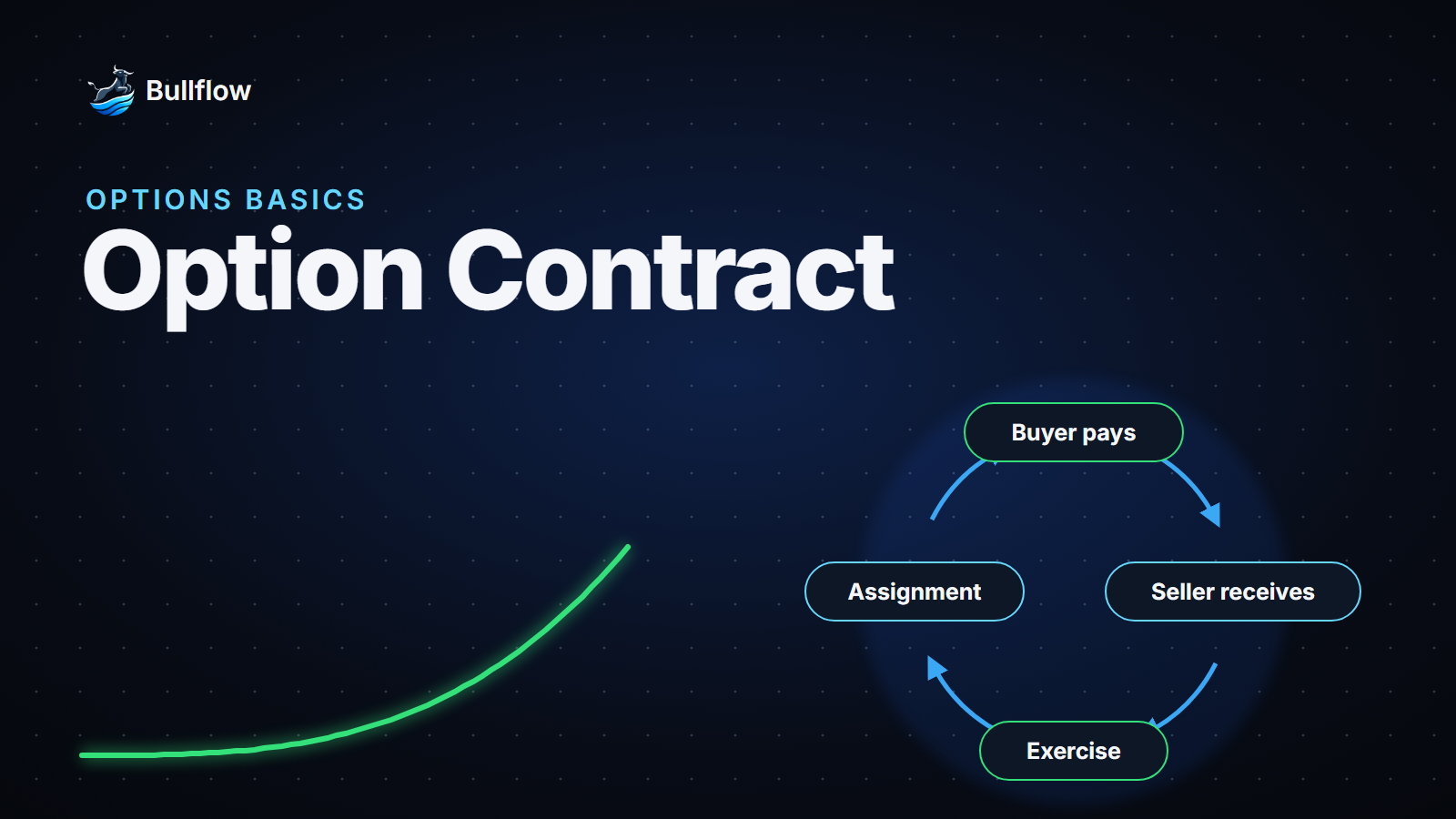
An option contract gives the buyer a right, not an obligation, to buy or sell a stock at a set price by a set date. The seller, called the writer, takes on the obligation if the buyer uses that right. For most stock options, one contract covers 100 shares.
The buyer pays a price for that right, called the premium. The premium is quoted per share, so one contract costs 100 times the quote. Most contracts are never exercised. Historically, more than 72% of contracts are closed out in the market before expiration, 22% expire without value and 6% get exercised.
What an option contract says
An option contract has these terms:
- Underlying: the stock the contract is on, such as XYZ.
- Type: a call gives the right to buy the shares at the strike. A put gives the right to sell them.
- Strike: the set price per share at which those shares change hands if the right is used.
- Expiration: the last day the right exists. After that date the option ceases to exist.
- Multiplier: the number of shares each contract covers, usually 100.
Illustrative example: XYZ is a made-up stock at $50. An XYZ 50 call has a $50 strike. It covers 100 shares and lets its holder buy them at $50 on or before expiration. See call option.
A put option contract has the same terms. Only the right differs: the holder can sell the 100 shares at the strike. See put option for the put side.
The 100-share multiplier and what a contract costs
The premium is quoted per share, and the multiplier turns that quote into the cost of one contract.
Illustrative example: the XYZ 50 call is quoted at $2.00 a share. One contract costs $2.00 x 100 = $200. Three contracts cost $2.00 x 100 x 3 = $600.
For the buyer, the premium paid is the most that can be lost on the contract. The call buyer's break-even is the strike plus the premium per share. For the XYZ call that is $50 + $2.00 = $52 at expiration. Below $52 the call loses money, since the premium must be subtracted from any gain.
What a buyer can do with a contract
The holder has three choices: sell the option to another buyer, let it expire worthless, or exercise it. Exercising means using the right to buy or sell the shares at the strike.
Exercising has its own cost. For the XYZ call, buying 100 shares at $50 takes $5,000. That $5,000 is the cost of exercising, not of buying the contract, which cost $200.
Standardized contracts
Exchange-traded options are issued by The Options Clearing Corporation (OCC). OIC gives the basic terms for standardized equity options. Strikes are listed at set steps, such as 0.5, 1, 2.5, 5 or 10 points apart, depending on the price level.
The writer's side and assignment
The writer is the seller. Selling to open a short position obligates the writer to fulfill their side of it. For a call, the writer has the obligation to sell the shares. See sell call option and sell put option.
When a holder exercises, OCC assigns the exercise notice to a clearing member, and the firm then assigns it to one of its customers who has written that option. That is assignment. A writer who sells a put to open is obligated to buy the underlying security, if assigned. Illustrative example: an assigned XYZ 50 call writer is obligated to sell 100 shares at the $50 strike, which is 100 x $50 = $5,000 for one contract.
When the terms of a contract change
The 100-share size can change. OIC says adjustments to a contract's size, deliverable or strike price may be made. After a reverse split, for example, the number of shares deliverable generally changes while the aggregate exercise price stays the same.
OCC publishes an Information Memo with the adjustment details, so read the terms there.
How contracts and premium relate in real SPY trades
Bullflow's options flow data lists each listed trade's number of contracts and its total premium in dollars. Its API docs describe the fields as total premium in USD, option fill price in USD per share, and number of contracts. Total premium is in US dollars. In the docs' example row, it equals the fill price times the contracts times 100.
Reversing the docs' example row, divide total premium by the contracts, then by 100 to get the premium per share. Illustrative example: 500 contracts with $150,000 of total premium is $300 a contract, or $3.00 a share.
SPY is the SPDR S&P 500 ETF Trust. State Street says it seeks results that, before expenses, correspond generally to the price and yield performance of the S&P 500 Index. These are 5 of the largest SPY trades by premium in Bullflow's closing summary on Nov 25, 2026:
| Type | Strike | Expiration | Contracts | Premium |
|---|---|---|---|---|
| Put | 740 | 2026-12-18 | 3,107 | $13.1M |
| Put | 750 | 2026-11-30 | 3,570 | $12.8M |
| Put | 750 | 2026-11-30 | 3,100 | $10.6M |
| Put | 745 | 2026-11-30 | 3,040 | $9.5M |
| Put | 850 | 2029-01-19 | 433 | $6.8M |
Source: Bullflow free closing options flow summary and closing GEX summary (for the close), SPY, Nov 25, 2026 (API docs).
SPY closed at $715.67 that session. The first row is 3,107 contracts for $13.1M of premium. SPY closed below the $740 strike, so this put was in the money at the close. A put is in the money when the underlying price is below the strike. The fifth row has far fewer contracts, 433, for $6.8M, so its price per share is higher. Contract count alone doesn't set premium.
The table has no price per share. It also doesn't show whether a trade bought or sold, or opened or closed a position, so five puts don't mean five bearish bets. See unusual options flow, or options flow for SPY.
Option contract FAQ
How many shares does one option contract cover?
Equity option contracts usually represent 100 shares of the underlying stock. Adjustments can change the size, so check the terms after a corporate action.
How much does one option contract cost?
The quoted premium is per share, so one contract costs the quote times 100.
Do I have to exercise an option contract?
No. The holder can sell the option to another buyer or let it expire worthless. Historically, only 6% of contracts get exercised.
What happens to an option contract after a reverse stock split?
The shares deliverable generally change while the aggregate exercise price stays the same, per OIC's note on splits. OCC publishes an Information Memo with the details.
What does the seller of an option contract take on?
The writer takes on the obligation to sell the shares if a call is assigned. A put writer is obligated to buy the underlying security if assigned.
Related: options trading for beginners.
Drafted with AI help; figures checked by the Bullflow team.
For information only. Not investment advice. Options carry significant risk and are not suitable for all investors.