 Bullflow
0DTE Options: Same-Day Expiration Explained
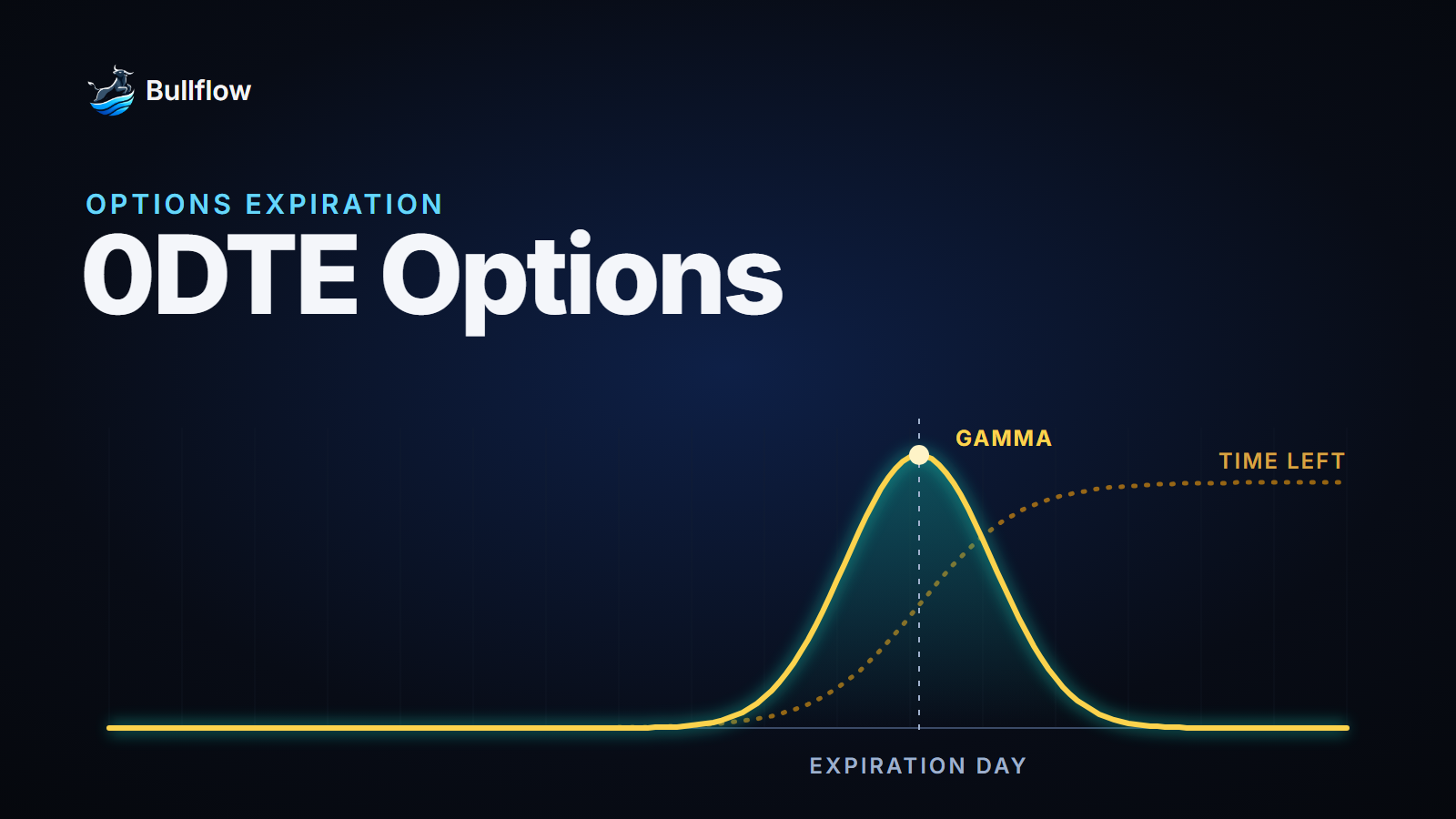
0DTE options are options with zero days to expiration. They expire at the end of the current trading day, which is why Cboe also calls them "same day expiring" options. Any option is a 0DTE option on its expiration day.
The terms below are the ones this post uses. For calls and puts side by side, read call option vs put option. New to options? Start with options trading for beginners.
Option terms used in this post
- Option: a contract to buy or sell a specific financial product.
- Call: the holder has the right to buy the underlying instrument at the strike price on or before expiration. As the stock rises, a call's value will generally increase.
- Put: the holder has the right to sell the underlying instrument on or before expiration. As the stock rises, a put's value will generally decrease.
- Strike price: the specific price at which the contract may be exercised, or acted upon.
- Premium: the purchase price of an option.
- Writer: the person who sells an option to open a position. If the holder exercises, the writer must fulfill their side of the contract.
- In the money: a call is in the money when the stock is above the strike. A put is in the money when the stock is below the strike. An option that is not in the money at expiration is assumed worthless.
Why traders use 0DTE options
Cboe, which lists SPX and XSP options, gives these reasons on its 0DTE page:
- Users can take very short-term positions and hedges on the market.
- The outcome of the trade is known the same day.
- Less capital is needed than for equivalent strikes with further-dated expirations.
- Options are available every trading day, which Cboe calls more flexibility.
These are Cboe's reasons, not a view that 0DTE options suit anyone. The same page says these products involve the risk of loss, which can be substantial.
Which 0DTE options exist
Whether an option is 0DTE depends on its date, not its name. Cboe says an option may expire quarterly, monthly, weekly or even several times a week, depending on the underlying asset. An option listed for weeks becomes 0DTE on its last day.
So the real question is which products list expirations on which days. Three examples:
- SPX and XSP: products Cboe names on its 0DTE page. Cboe says SPX options provide broad exposure with cash settlement. XSP options are 1/10th the size of standard SPX contracts.
- SPY, IWM and QQQ: a January 2026 filing says the Miami International Securities Exchange (MIAX) permits expirations in these on Mondays through Thursdays. SPY is the SPDR S&P 500 ETF Trust. An ETF is an exchange-traded fund that pools money from many investors and invests in stocks and other securities.
- GLD, SLV, TLT, USO and UNG: the same filing lists GLD, SLV and TLT on Mondays and Wednesdays. It lists USO and UNG on Wednesdays.
That filing covers one exchange and the products it names. It doesn't list every option with a same-day expiration.
A 0DTE option in an illustrative example
All numbers in this example are made up. Stock XYZ trades at $100 at the open. A holder pays $0.50 a share for an XYZ 100 call that expires that day. One contract usually covers 100 shares, so the premium is $50. At the close, the call is worth $100 for each $1 that XYZ ends above $100.
- XYZ at $100 or below: the call is worth nothing. The $50 premium is gone.
- XYZ at $100.50: the call is worth $50. That is the break-even: the strike plus the premium.
- XYZ at $101: the call is worth $100, a $50 gain after the premium.
A put with the same $0.50 premium works in reverse:
- XYZ at $100 or above: the put is worth nothing. The $50 premium is gone.
- XYZ at $99.50: the put is worth $50, the break-even: the strike minus the premium.
- XYZ at $99: the put is worth $100, a $50 gain after the premium.
Earlier in the day, XYZ could still move back. At the close, there is no time left to do so.
Why gamma and time decay matter on the last day
This section covers two Greeks, gamma and theta. Greeks are the measures investors turn to for guidance on how options may react to a change in a pricing input.
Delta is a theoretical estimate of how much an option's premium may change given a $1 move in the underlying. Gamma is how much delta is expected to change for a $1 move in the stock. The Options Industry Council (OIC) says gamma is higher for options that are at the money and closer to expiration. At the money means the current market value of the underlying equals the strike price.
On the last day, an option at the money has a higher gamma than the same option would with more time left. Its delta is expected to change more for each $1 move. For more, read gamma in options.
Theta is how much an option's premium may lose per day from time passing. OIC says the rate of decay tends to rise as expiration gets closer. OIC says an option's premium has two main components: intrinsic value and time value. Only in-the-money options have intrinsic value. Time value is any premium in excess of intrinsic value before expiration. Upon expiration, an option has no time value and is worth its intrinsic value only.
Cboe says near-the-money options are extremely sensitive to moves in the underlying index as expiration approaches.
Risks of 0DTE options
- Little time to recover: an option that moves against its holder has only until the close to come back.
- A whole premium can vanish: in the XYZ example, the $50 premium goes to zero if XYZ finishes at $100 or lower.
- Writers carry different risk: a writer collects the premium and must fulfill their side of the contract. OIC says the loss potential from writing an uncovered index option is generally unlimited.
- Exercise and assignment: OIC says a writer may be assigned an exercise notice on a short option position at any time before expiration. The holder of an American-style option can exercise at any time before expiration. Early assignment is possible but not always predictable.
Settlement: SPX vs SPY
Settlement is how an exercised option is paid. It works in one of two ways. Cash-settled means cash changes hands. Physically settled means shares change hands.
Exercise style is when the holder may exercise. An American-style option can be exercised on any business day up to expiration. A European-style option can be exercised only on the day of expiration.
| SPX | SPY | |
|---|---|---|
| Underlying | An index | An ETF |
| Settlement | Cash | Shares, as with standard ETF options |
| Exercise style | European, only at expiration | Generally American, any business day up to expiration |
SPX positions "settle directly to cash at expiration without the need to deliver or receive unwanted shares," says Cboe. OIC says standard equity options, including ETF options, are physically settled with an exchange of shares. OIC says equity options generally have only American-style exercise. OIC does not name SPY options, so the SPY column applies its description of standard equity and ETF options.
Illustrative: if an SPY 755 call is exercised, 100 SPY shares change hands at $755 each, or $75,500. An SPX option settles for cash instead.
Trading ends at different times. Cboe's specifications say SPXW options ordinarily stop trading at 4:00 pm ET on expiration day, and at 1:00 pm ET on a half-day holiday. Standard SPX options ordinarily stop on the business day before the expiration date, at 5:00 pm ET.
Same-day trades in Bullflow's options flow
The table below shows what large SPY option trades looked like in one session, and which of them were same-day.
Bullflow's free closing summary holds up to 12 largest-premium trades per session in SPY options. The table is the session's 12 largest-premium trades, a selection by premium and not the full list of trades. The rows whose expiration is Nov 13, 2026, the session date, are the same-day trades.
| Time | Type | Strike | Expiration | Contracts | Premium | Fill |
|---|---|---|---|---|---|---|
| 15:28 UTC | Call | 700 | 2028-12-15 | 599 | $8.8M | Ask |
| 15:43 UTC | Call | 600 | 2027-06-30 | 200 | $3.4M | Ask |
| 19:55 UTC | Call | 840 | 2028-12-15 | 500 | $3.3M | Ask |
| 17:06 UTC | Put | 755 | 2026-11-13 | 7,828 | $3.2M | Below Bid |
| 15:26 UTC | Put | 737 | 2026-11-20 | 6,058 | $2.4M | Below Bid |
| 16:17 UTC | Put | 755 | 2026-11-13 | 4,000 | $2.4M | Above Ask |
| 16:16 UTC | Call | 900 | 2028-12-15 | 600 | $2.4M | Bid |
| 21:09 UTC | Put | 724 | 2026-11-30 | 9,000 | $2.4M | Below Bid |
| 16:26 UTC | Put | 760 | 2027-01-15 | 1,047 | $2.3M | Below Bid |
| 15:20 UTC | Call | 750 | 2027-04-16 | 600 | $2.2M | Ask |
| 14:59 UTC | Put | 718 | 2026-12-18 | 4,000 | $2.2M | Ask |
| 17:00 UTC | Call | 900 | 2028-12-15 | 510 | $2.0M | Ask |
Source: Bullflow free closing options flow summary and closing GEX summary (for the close), SPY, Nov 13, 2026 (API docs).
What each column means:
- Time: when the trade happened, in UTC (Coordinated Universal Time), not New York time.
- Type: call or put.
- Strike and Expiration: the contract's strike price and expiration date.
- Contracts: how many contracts traded.
- Premium: the total dollars of premium for the trade.
- Fill: where the trade executed against the quote. The bid is the highest price a buyer will pay. The ask is the lowest price a seller will accept, per the SEC's Investor.gov. Bullflow marks trades as Below Bid, Bid, Ask or Above Ask, the side of the quote each trade filled on.
Bullflow's documentation says execution-side direction does not establish opening positions or trader intent. So the table can't show whether a trade opened or closed a position.
These are the rows that expire Nov 13, 2026:
- Put, 7,828 contracts: a $755 strike for $3.2M, fill: Below Bid. SPY closed below the $755 strike, so this put was in the money at the close.
- Put, 4,000 contracts: the same $755 strike for $2.4M, fill: Above Ask.
Read these rows with three limits:
- A premium ranking can leave out same-day trades. The table can't show how common 0DTE trades are.
- In the money at the close says nothing about profit. That depends on the premium paid, as the XYZ call at $100.50 shows.
- The table covers one session's largest-premium trades. It says nothing about smaller trades.
See live SPY activity on Bullflow's SPY options flow page, or options flow for other tickers.
0DTE options FAQ
Which options can be 0DTE options?
Any option can be, on its expiration day. Which products have a same-day expiration on a given day depends on the expirations their exchanges list. Cboe's 0DTE page features SPX and XSP. A January 2026 MIAX filing lists SPY, IWM and QQQ on Mondays through Thursdays.
What time do SPX 0DTE options stop trading?
Cboe's specifications say SPXW options ordinarily stop trading at 4:00 pm ET on expiration day, and at 1:00 pm ET on a half-day holiday. That page is a snapshot dated March 19, 2024, so check Cboe for current hours.
Are SPX 0DTE options cash-settled?
Yes. Cboe says SPX positions settle directly to cash at expiration, and its 0DTE page lists SPX options with cash settlement and European-style exercise. SPY options are different: standard equity options are physically settled with an exchange of shares.
Why is time decay faster for a 0DTE option?
OIC says theta, the premium an option may lose per day, tends to rise as expiration gets closer. OIC also says that upon expiration, an option has no time value and is worth its intrinsic value only.
Drafted with AI help; figures checked by the Bullflow team.
For information only. Not investment advice. Options carry significant risk and are not suitable for all investors.